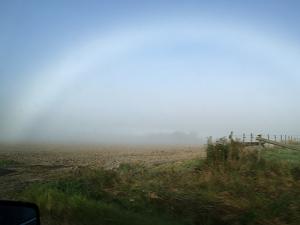
poważnie, bardzo ciekawe zdjęcie i zjawisko NN
wybielona tęcza?
zmęczona tęcza?
niewyspana tęcza?
już wiem: tęcza zanim się ubrała!
serdeczności
E
_________________ przestrzeń
składa się z czasu
pokonywania
prostą linią
myśli
zakrętem pytania
zdecydowaniem
kropki śmierci
po wielokropku
umierania
E
poniżej notka dla wszystkich Naukowców krainy PeeS
myślę, że można znaleźć jakiś artykuł na ten temat po polsku...
Jest! chociaż zdjęcie z Kaliforni, ale notka po polsku:
http://www.niewyjasnione....9cza-t8534.html
Okazuje się, że biała tęcza, albo mgielna tęcza, albo psy mgły, albo łuki chmur - jak to ładnie nazywają Ci co nazywają - jest rzadkim zjawiskiem. Jeszcze rzadszym do sfotografowania, więc NN prześlij Darkowi gratulacje
"How about fog bows? Yes, fog bows, also known as fog dogs, cloud bows or white rainbows, can be observed on occasion. But even when one has formed, it may go unnoticed, since fog dogs are generally bereft of color. Whereas rain drops may be 0.5 mm in diameter, fog droplets are typically less than 1/10 this diameter. If you happen to see such a bow, you may notice that it's broader than a rainbow (rainbows cover about 2 degrees of the sky or about 4 times the width of the Sun or Moon), and there may be an orange tint on the outer portion of the bow. Actually, fog bows are caused by a diffraction of light rather than refraction and reflection. Because the fog droplets are so tiny, the wavelengths of visible light, which are obvious in the larger drops producing the rainbow, interfere with each other. The result is color bands that overlap. As the droplets get smaller, the interference is even greater, and the light that emerges is completely colorless. As with rainbows, in order to see a fog bow, you need to look in the opposite direction of the Sun."
_________________ przestrzeń
składa się z czasu
pokonywania
prostą linią
myśli
zakrętem pytania
zdecydowaniem
kropki śmierci
po wielokropku
umierania
E